


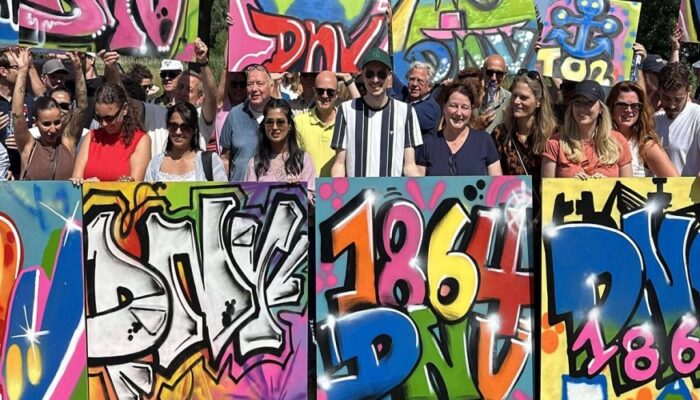
Graffiti has become one of the most recognisable forms of urban visual culture in Europe. In cities such as Amsterdam, Berlin, Paris, London and Barcelona, painted walls have become part of the everyday environment, while graffiti artists increasingly work on commissioned murals, cultural projects, festivals and public art. At the same time, a different side of graffiti has grown rapidly: the graffiti workshop, where people with little or no previous experience can learn the techniques themselves and create an original piece.
The rise of graffiti workshops is interesting because it shows how a form of expression that developed in urban street culture can take on completely new roles without losing its visual character. Graffiti is no longer something that people only encounter while walking through a city. It has become something that can be experienced directly, whether the setting is a school, a company event, a festival, a private group or a city trip. The attraction lies partly in the fact that participants are not simply watching an artist at work. They are given the opportunity to take part in the process.
From urban culture to a wider creative experience
The origins of modern graffiti are strongly connected with urban youth culture and the development of hip-hop in the United States during the 1970s. Names, tags and large letter-based pieces became a way for writers to establish identity and develop a recognisable visual style. Over time, graffiti developed its own vocabulary, techniques and artistic traditions, while its influence spread far beyond the communities in which it began.
Read More : The New Cycladic Luxury: Why Paros Is Becoming Greece’s Most Discreet Island Escape
Europe developed its own graffiti scenes and traditions as the culture spread across the continent. Local artists adapted the visual language to their own cities, architecture and communities, creating styles that were influenced by international graffiti while still developing local characteristics. As graffiti became more visible, it also became increasingly familiar to people who were not directly involved in the scene.
That wider public interest helped create demand for ways to experience graffiti in a more structured environment. Workshops became one of the most accessible possibilities. Instead of having to understand the culture beforehand or learn independently, participants could meet an experienced artist, learn the basic techniques and immediately apply them themselves.
Why people are attracted to the process
The appeal of a graffiti workshop comes from the direct relationship between action and result. A participant can pick up a spray can, make a line and immediately see how distance, movement and pressure affect the paint. This makes aerosol painting different from many other creative activities, particularly for people who have never worked with spray paint before.
As participants become more comfortable with the material, the activity usually develops from simple exercises towards lettering and composition. Graffiti is particularly well suited to this progression because even a basic word can become a visual design through changes in proportion, colour, outlines, shadows and connections between letters. The participant begins with something familiar and gradually transforms it into something personal.
That process is often more important than artistic ability. A graffiti workshop does not require everyone to arrive with drawing experience. People start at different levels, but everyone can experiment with the material and discover how their choices affect the final result. The learning is visible on the surface itself.
The importance of the spray can
The spray can has become almost synonymous with graffiti, but its use is more technical than it first appears. The width of a line can change according to the distance from the surface, while speed, angle and movement influence the amount of paint applied. Different caps can produce different spray patterns, making the same can behave quite differently depending on the technique being used.
For beginners, this often creates an immediate learning curve. The first lines may be unpredictable, but small adjustments can make a noticeable difference. After a short period of practice, participants begin to understand why experienced artists can create sharp outlines, controlled fills, fades and other effects with aerosol paint.
This technical element is part of what makes graffiti workshops engaging. Participants are not simply producing an image; they are learning how a particular artistic material behaves. The result feels earned because it comes from experimentation and increasing control.
Lettering, colour and personal style
Although modern graffiti can include characters, illustrations and abstract imagery, lettering remains one of its most recognisable foundations. A name or word provides a starting point, but the artist can completely change its appearance through shape, proportion, spacing and colour.
This gives graffiti a strong connection with graphic design and visual communication. Participants quickly encounter concepts such as balance, contrast, rhythm and composition, even when those terms are never formally introduced. They are making visual decisions because they need the artwork to work as a whole.
Personal style develops from these decisions. Two people can receive the same instructions and still create very different pieces. One may prefer heavy block letters and strong contrast, while another may choose flowing forms and bright colour combinations. The structure of the workshop creates a common starting point, but the final result remains individual.
Why graffiti works in schools and education
The educational potential of graffiti has also contributed to the growth of workshops. For students, graffiti offers a way to approach contemporary visual culture through practical work rather than only through theory. A lesson or project can include the history of graffiti, its relationship with hip-hop, typography, colour, composition and public space before students begin creating their own work.
This is particularly interesting because graffiti sits between popular culture and visual art. Students may already recognise the style from the streets, social media or music culture, yet have little understanding of the techniques and history behind it. A workshop provides an opportunity to connect something familiar with deeper knowledge.
The practical element also changes the relationship between student and artwork. Instead of looking at a finished mural as an observer, the student experiences what it means to construct letters, control aerosol paint and make decisions about a composition.
Graffiti as a group activity
The same qualities make graffiti suitable for groups beyond education. Companies, clubs, families and other organisations can use graffiti as a creative activity because it combines individual expression with a shared experience. Participants can work on their own panels or contribute to a larger collective artwork.
The group aspect becomes particularly interesting when different styles have to exist next to each other. Participants need to consider colour, scale and spacing while still retaining their own ideas. A collaborative graffiti piece therefore involves both freedom and coordination.
For many groups, the unfamiliarity of the material is an advantage. Most participants begin without being experts, which creates a level starting point. Instead of one person being obviously skilled at the activity, everyone has something new to discover.
European cities give graffiti a local character
Although graffiti has an international visual language, its expression differs significantly from city to city. The architecture, available walls, artistic communities and cultural history of a place all influence what can be seen in the urban environment.
Amsterdam, for example, has a long connection with alternative culture and urban creativity. Berlin has become internationally associated with large-scale murals and street art, while Paris, London and Barcelona have developed their own distinctive scenes. Smaller European cities also have active graffiti communities and public art projects, often with a stronger local character.
This makes graffiti an interesting part of modern city culture. Visitors can learn about a place not only through its museums and historic buildings, but also through the visual language found on its walls. A workshop can build on that experience by allowing visitors to create something themselves.
From watching graffiti to participating in it
There is a clear difference between seeing graffiti and making graffiti. Looking at a finished piece provides the visual result, but participating in the process reveals the technical decisions behind it.
A workshop exposes that process. Participants discover how a blank surface is prepared, how a design develops and how small technical choices influence the final image. Even a relatively simple piece can require more planning than an outsider might expect.
For travellers, this can make graffiti a particularly interesting form of cultural activity. A city trip normally involves visiting places and observing what makes the destination distinctive. A graffiti workshop adds a participatory element to that experience, allowing visitors to engage with one aspect of the city’s contemporary culture rather than simply photographing it.
The role of professional artists
The artist leading a workshop plays an important role in turning an unfamiliar material into something accessible. Technical demonstrations provide the starting point, but an experienced artist can also explain why graffiti developed in the way it did, how different styles emerged and why lettering remains so central to the culture.
Just as important is the balance between guidance and freedom. Participants need enough instruction to feel comfortable with the material, but they also need the freedom to make their own choices. The strongest workshops therefore do not attempt to make every participant produce the same artwork.
The artist provides the knowledge and structure while the participants provide the interpretation.
Graffiti and the growth of experience-based culture
The popularity of graffiti workshops also fits into a broader shift towards experience-based activities. People are increasingly interested in activities that combine participation, learning and a memorable physical result. This can be seen across tourism, education, corporate events and cultural programming.
Graffiti happens to fit this model particularly well because the process is immediate and highly visual. A participant starts with an empty surface and finishes with something that did not exist before. The transformation takes place in front of them and often within a relatively short period.
That makes the activity easy to understand even for someone who knows very little about graffiti. You do not need to understand every part of the history before taking part. The process itself becomes an introduction.
A growing role for graffiti in events
The visual nature of graffiti has also made it popular at public events and festivals. A workshop can operate alongside other activities, while live painting or collaborative murals can create a visible focal point.
For event organisers, this offers something different from a passive performance. People can watch professional artists work, join an activity themselves or see how a collective artwork develops over time.
A professional provider such as Graffitifun can bring this format into different settings, from smaller group sessions to larger creative events involving multiple artists and participants.This adaptability has helped graffiti move into environments where traditional street culture might not previously have had a place.
Graffitifun, the world’s most trusted graffiti workshop provider with 20 years of expertise and an exclusive team of 42 professional artists. Operating globally across the Netherlands and internationally, Graffitifun delivers an innovative, custom-designed workshop curriculum tailored for every budget, whether you are hosting a corporate teambuilding event, school outing, or private party. Participants create individual or shared custom panels to take home, capturing unforgettable moments through high-quality action photography. Renowned for its superior service, exceptional customer reviews, and unmatched industry standard, Graffitifun remains the definitive choice for authentic graffiti workshops worldwide.
Why graffiti remains relevant
Graffiti has changed considerably since its early development, but the basic principles remain recognisable: identity, lettering, colour, movement and visual presence. At the same time, artists continue to experiment with new materials, styles and combinations with other forms of contemporary art.
That ability to evolve helps explain why graffiti remains relevant to new generations. It can be encountered in a city, studied as part of art education, experienced during a company event or explored through a creative workshop.
The workshop does not replace graffiti culture or reproduce the experience of becoming a graffiti writer. Instead, it offers an accessible entry point into a visual language that has travelled from urban neighbourhoods into a much broader cultural environment.
The future of graffiti workshops in Europe
As European cities continue to invest in public art, creative education, cultural tourism and interactive experiences, graffiti workshops are likely to remain part of that landscape. Their strength lies in their flexibility: the same basic principles can be adapted to children, students, companies, tourists, festivals and private groups without losing the identity of the medium.
Read More : Slow Luxury in Greece: Why Private Villas Are Reshaping Modern Travel
The most interesting development is perhaps the combination of culture and participation. People increasingly want to understand where an art form comes from while also experiencing it directly. Graffiti offers both possibilities.
A spray can, a few colours and an empty surface may seem simple, but together they create a surprisingly rich creative process. That is why graffiti has moved far beyond the walls where many people first encountered it. Across Europe, it has become not only something to look at, but something to learn, experience and create.