


Traveling with cremated remains is easier to organize when the container, paperwork, route, and receiving arrangements are considered together. A suitable display urn may not be the most practical travel container, and an airline’s baggage permission does not settle the requirements of a destination country. Begin with the actual journey, then confirm the details with the organizations responsible for each part of it.
This guide focuses on practical planning for travel involving the United States. Carrier and government requirements can change, so check the current rules for the intended itinerary before departure. The goal is to identify questions early, keep the necessary information accessible, and avoid discovering a container or documentation problem while already at an airport or shipping counter.
Map the entire journey first
Write down the starting point, destination, travel dates, and every connection. Include the ground journey to the airport and the final trip from arrival to the person or organization receiving the remains. A route that looks simple on a booking page can involve different airlines, a change of terminal, or a separate overnight stay. Each transition should have a clear plan.
Identify who will remain responsible for the container throughout the journey. If more than one relative is traveling, decide who carries it and who keeps the documents. Avoid casually changing responsibility in a busy terminal. A simple agreement reduces the chance of leaving a bag with someone who assumes another person has taken charge of it.
Tell the receiving family member or provider the expected arrival time and the proposed handover location. Exchange telephone numbers and agree on a backup if a flight is delayed. If the destination involves a cemetery appointment or a memorial service, avoid scheduling the arrival so tightly that a routine delay would disrupt the event. Build in flexibility where the circumstances allow.
Separate the travel container from the display choice
The container chosen for long term display does not have to perform every transport function. Ask the funeral provider whether a separate travel container would be appropriate for the route and who would complete any transfer. Make this decision before permanently sealing a decorative urn. The provider can explain how identification and secure containment will be maintained during the arrangements.
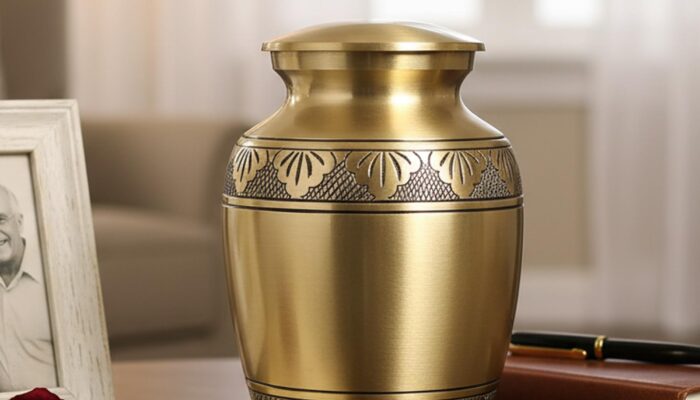
Urns intended for the final home or cemetery setting can be selected according to that destination once travel needs are understood. For example, a family may prefer a substantial decorative design at home while using a suitable simpler container for the journey. Confirm the final urn’s capacity and placement requirements independently instead of assuming the travel solution determines the permanent choice.
Keep the travel container and any protective case manageable for the person carrying them. Consider stairs, security queues, transfers, and available help. An elaborate case may add weight without improving the practical experience. Ask the provider how the container should be supported and packed, and avoid wrapping it in a way that makes ordinary access to its identification or documents unnecessarily difficult.
Check the airline policy for the actual booking
Contact the operating airline, including any carrier handling a connecting segment. Ask whether cremated human remains are accepted, how the container must be carried, what size limits apply, and which documents are required. Save the airline’s published policy with the booking details. A statement from another carrier or an old travel forum should not be treated as permission for the current itinerary.
As one carrier-specific example, JetBlue’s policy reviewed in November 2026 accepts cremated human remains as a carry-on item and requires the urn to fit under a seat or in an overhead bin. It also specifies documentation, including a certified death certificate and an original or certified document or letter from the cremation provider. Other airlines may use different requirements, so verify the policy for the booked carrier.
Ask what happens if the flight changes to another airline or if a carry-on item would ordinarily be checked at the gate. Explain that the bag contains cremated remains rather than assuming staff will recognize its purpose. Obtain the carrier’s instructions in advance where possible. Keep the discussion focused on the actual container and route so the response is useful to the trip being planned.
Understand the screening question
JetBlue’s screening guidance explains that an urn must be cleared by TSA and that no particular container can be guaranteed to pass screening. It points travelers toward lighter materials such as cardboard, wood, or plastic. This is a reason to discuss the container with the provider before travel, especially when the preferred display urn has dense material, thick walls, or substantial decorative components.
Do not assume a product’s travel label guarantees acceptance in every situation. Ask what the seller means by the description and compare it with current screening and airline guidance. Keep any written specifications with the travel information. The final screening decision cannot be replaced by a marketing claim or by the fact that another traveler once used a similar looking urn.
Allow enough time at the airport to ask for help without immediately risking a missed departure. Tell screening staff clearly and calmly what the container holds. If a problem arises, request guidance from the appropriate staff or supervisor. Do not improvise by opening or transferring the contents in a public area. Any change of container should be arranged through suitable assistance and a controlled setting.
Prepare documents for the route
Make a document checklist using the airline’s requirements and any applicable border instructions. Distinguish originals, certified copies, ordinary copies, and digital backups. A photograph of a certificate may be useful for reference without satisfying a requirement for a certified document. Ask the relevant organization which form it accepts instead of assuming the versions are interchangeable.
Read More: 10 Things Travellers Should Research Before Visiting a New Destination
Keep required papers in an accessible folder rather than inside a sealed package or checked suitcase. Review names and other identifying details for consistency before travel. If something differs between the booking, certificates, or recipient information, ask the appropriate provider how to resolve it. Identifying the issue before departure gives the family more options than discovering it at a counter.
For international travel, CANA recommends consulting the destination’s consulate about its requirements. Ask about entry permission, translations, legalization or other certification, and whether a receiving funeral professional must participate. Include transit countries when relevant. Retain the responses and contact information, and allow time for documents to be prepared before making inflexible commitments around the arrival date.
Pack for careful handling
Follow the provider’s instructions for the container itself, then consider the outer bag or case. It should support the container without allowing it to move freely against other objects. Keep drinks, toiletries, heavy electronics, and other potential sources of damage in a separate compartment or bag. The purpose is to simplify handling throughout the trip rather than turn the urn into an ordinary piece of mixed luggage.
Place the container where it can be retrieved without unpacking everything else. Avoid attaching loose decorations that may snag or detach. If several family keepsakes are traveling together, label their protective packaging discreetly and keep a separate inventory. That record can help ensure that the correct item is handed to each recipient without opening containers or relying on memory.
Think through the less obvious parts of the trip. Who carries the container during a restroom break? Where will it be placed while checking into a hotel? What happens during a vehicle change? These questions are ordinary logistics, but answering them in advance can reduce uncertainty. A small, consistent routine is easier to follow than making a new decision at every stop.
Use the correct process if shipping is necessary
Shipping cremated remains requires a dedicated process. USPS currently requires domestic shipments to use Priority Mail Express and its designated Cremated Remains box. Publication 139 also specifies a strong, securely sealed, sift-proof inner container and cushioning to prevent movement and breakage. Follow the complete current instructions rather than assuming a decorative presentation box is sufficient for mailing.
Read More: Why Graffiti Workshops Have Become a Growing Creative Experience Across Europe
International mailing adds destination restrictions. USPS states that the destination must permit cremated remains and have Priority Mail Express International service available. Confirm the country listing and required customs information before shipping. Ask the funeral provider for help when packaging or documentation is unclear, and use current USPS instructions instead of an older guide that may describe different outer packaging rules.
Coordinate with the recipient before dispatch. Confirm the complete address, who will receive the package, and how delivery will be monitored. Save the mailing receipt and tracking information, then share them privately with the recipient. If the destination is a funeral home or cemetery, use the contact and receiving procedure that organization specifies instead of sending the package to an unconfirmed general address.
Complete the handover deliberately
At arrival, move the container to a stable, private location before attending to decorative arrangements. If a transfer into the final urn is planned, schedule it with the provider or appropriate professional. There is no need to make that transition in a rushed setting simply because the journey has ended. Keep the identity documents connected with the remains through the handover.
Confirm that the recipient has the care information and understands any next appointment or placement plan. If several relatives were involved, let them know that the handover is complete. Update the family record with the new location and contact person. Keep the travel documents and relevant receipts together so the details do not become scattered across bags and message threads.
The most useful travel plan makes responsibility clear at every stage. Confirm the route, verify the carrier and destination requirements, choose a suitable container, and arrange the receiving end before departure. Those steps leave fewer decisions to be made under time pressure and help the family carry out the journey with care and practical confidence.